Created by Vivian Todhunter, this series of PowerPoints introduces students to EMRs, and provides them with practice tasks in an actual EMR system: demos site... Read More
Created by Vivian Todhunter, this series of PowerPoints introduces students to EMRs, and provides them with practice tasks in an actual EMR system: demos site... Read More
Created by Vivian Todhunter, this series of PowerPoints introduces students to EMRs, and provides them with practice tasks in an actual EMR system: demos site of OPEN-EMR.
Created by Vivian Todhunter, this series of PowerPoints introduces students to EMRs, and provides them with practice tasks in an actual EMR system: demos site of OPEN-EMR.
Health Information Technology for Nurses — 6 Hours
In this course PN students will demonstrate an understanding of the role of Health Information Technology in healthcare. Students will review HIT fundamentals, its history, its importance in the clinical environment, and its value in promoting patient safety. Students also will review HIPAA, CPOEs, clinical decision-support systems, (CDSs), and EHRs, EMRs, and HIEs. Students will explore their knowledge of legislation affecting healthcare and emerging trends that may impact patient care. Finally, through scenarios, simulations, and other exercises, students will practice their knowledge and skills in HIT.
Introduction to Medical Imaging Systems
This Storyline activity created by Brooke Mackenzie with visual aids created by Center for Applied Technologies (CAST) introduces students to Medical Imaging Information System, and provides them with a practice scenario.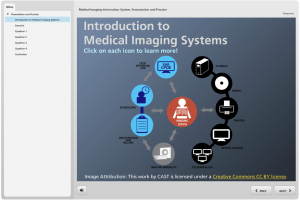
Created by: Emily Wood, Pierce College
For Infusion into: Medical Office Assistant
Objective(s):
Identify the basic characteristics of healthcare delivery organizations including various roles and challenges associated with the healthcare delivery organization.
Describe challenges associated with healthcare delivery organizations including current and possible trends.
Created by: Matt Beil, Clover Park Technical College
For infusion into: Hemodialysis
Objective: Explain how consumers approach automated systems from the point of view of usability and cognitive design